Dear Members of Istanbul Technical University,
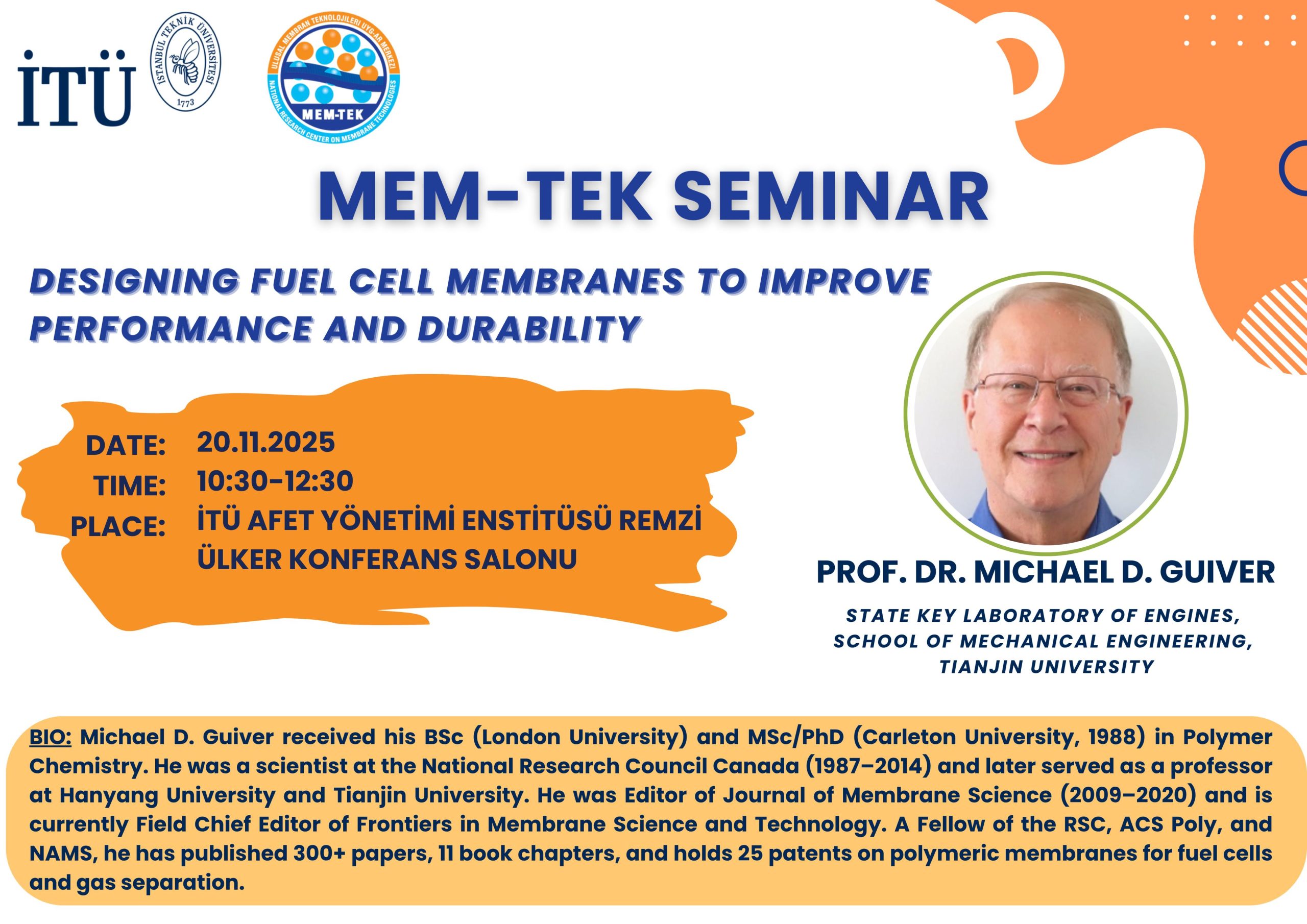
As part of the seminar series organized by the ITU Prof. Dr. Dincer Topacık National Research Center on Membrane Technologies (MEM-TEK), we are pleased to host Prof. Dr. Michael D. Guiver from the State Key Laboratory of Engines, School of Mechanical Engineering, Tianjin University.
Prof. Guiver will deliver a talk entitled “Designing Fuel Cell Membranes to Improve Performance and Durability,” focusing on the latest developments and innovative approaches in fuel cell membrane design for enhanced performance and long-term durability.
📅 Date: November 20, 2025 (Thursday)
🕥 Time: 10:30 – 12:30
📍 Place: ITU Disaster Management Institute, Remzi Ülker Conference Hall
🔬 Abstract:
Interest in hydrocarbon-based proton exchange membranes (PEM) stems from potentially replacing perfluorosulfonic acid membranes (Nafion) in fuel cells (FC) and other electrochemical applications due to environmental, cost, and operational advantages at higher temperatures and lower humidity. However, their conductivity and chemical stability during in situ FC operation often fall short of expectations.
Recently, research has focused on anion exchange membranes (AEM), which allow the use of non-PGM catalysts, though challenges remain in alkali stability and CO₂ sensitivity.
We have explored efficient ion conduction in hydrocarbon-based PEMs and AEMs by constructing through-plane channels—shortening the ion transport pathways between anode and cathode—using paramagnetic polymers aligned in a magnetic field. These PEM channels contain ferrocyanide linked with phosphotungstic acid and exhibit microporosity, retaining water at elevated temperatures and enabling strong performance under low humidity.
Unexpectedly, the membranes displayed remarkable oxidative stability and stable PEMFC performance due to the radical-quenching effect of ferrocyanide. We further stabilized PEMs using ferrocyanide–ferricyanide redox couples, applicable to both hydrocarbon and perfluorocarbon-based systems.
Additionally, AEMs incorporating ferrocenium cations exhibited aligned hydroxide-conducting channels and exceptional stability under mixed valence states, achieving 2 W cm⁻² power density and excellent durability at 100 °C in H₂/O₂ AEMFC operation.
All faculty members, researchers, and students are cordially invited to attend this seminar.
We look forward to your participation.
Kind regards,
ITU Prof. Dr. Dincer Topacık National Research Center on Membrane Technologies (MEM-TEK)
🌐 https://mem-tek.itu.edu.tr